A Volunteer Handover Before the Season Ends
A volunteer handover checklist helps the next organiser carry forward dates, useful contacts and unfinished tasks without relying on memory.
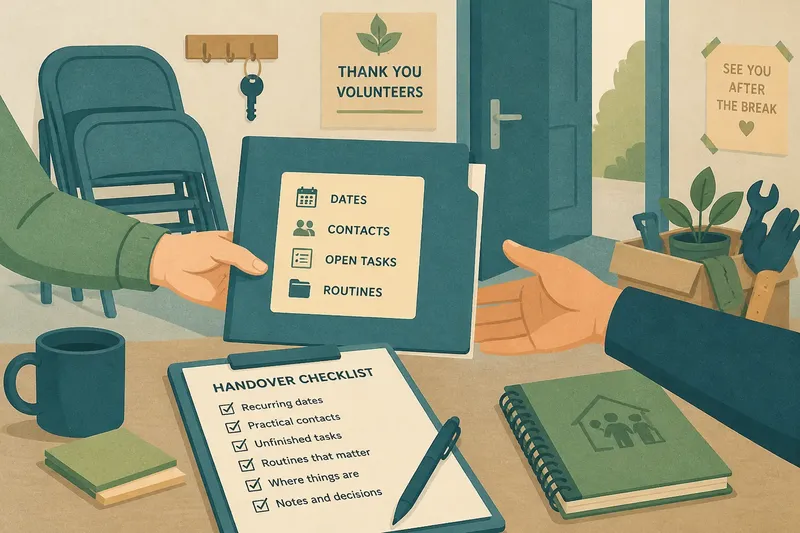
The last clean-up of the season is nearly done: folding chairs are stacked, the key is back on its hook, and someone asks who booked the room for the first gathering after the break. A volunteer handover checklist gives the next person a useful answer, along with the dates, contacts and open tasks that otherwise drift out of view.
Keep the handover centred on continuity, not a grand account of everything the group did. A shared document or folder is enough if the next volunteer can find it, understand it and update it. Before copying personal contact details or access information, agree what the group needs to retain and who may see it.
Record the recurring dates that shape the season
Write down the dates that return, not just the events that already happened. Include regular sessions, room-booking deadlines, application windows, maintenance days, community celebrations and the point when the next organiser should begin planning. A bare date can be hard to interpret later, so note what it relates to and whether it is fixed or provisional.
For each recurring date, capture:
- The activity or deadline it concerns.
- Its usual timing or the confirmed date, with the year included.
- Who normally confirms or books it.
- Any dependency, such as waiting for a venue calendar.
- Where the confirmation or booking record is stored.
Separate established dates from assumptions. “Usually the second Tuesday” is useful context, but it is not the same as a confirmed booking. Mark the next action clearly: confirm with the hall, check the school calendar, or ask the group before announcing it. This helps the incoming volunteer avoid repeating an old schedule simply because it appears in last season’s notes.
List practical contacts with a reason for each
A contact list is most useful when it explains why each person matters. Record the role, the best agreed way to make contact and the subject they can help with: room access, equipment, the shared garden, refreshments or the community noticeboard. Add an alternative contact where the group already has one, rather than leaving the next organiser to discover a single point of failure.
Use role-based addresses or group accounts where available. If a contact has agreed to be listed, include only details needed for the handover and store them in a place with appropriate access. Do not put door codes, account passwords or sensitive personal information into a broadly shared seasonal note. Where access needs changing, ask the responsible person to manage it through the group’s usual process.
Say you are handing over a neighbourhood repair afternoon. The outgoing volunteer could record that the caretaker confirms room access, the tool cupboard key is collected from the named coordinator, and the venue booking sits in the group’s shared calendar. The next volunteer can then check the calendar and contact the right people, rather than sending a vague message to everyone.
Describe unfinished tasks as the next action
“Garden sign needs sorting” is a reminder, but it leaves several questions unanswered. Is the sign damaged, awaiting permission, or simply not yet designed? Turn each open task into a short note that states the current position, the next practical action, and any deadline or dependency. If someone has already agreed to take it on, name the role or person only with their agreement.
Useful handover notes distinguish between work in progress and ideas for later. For an unfinished item, capture:
- What remains to be done.
- What has already been decided or completed.
- The next person or group decision needed.
- Any relevant deadline or waiting point.
- The file, supplier details or meeting note that provides context.
Keep the wording neutral. “No one followed up” can sound like blame and tells the incoming volunteer little. “Ask the venue whether the storage cupboard can remain available; request sent, reply pending” records the situation and makes the next move visible.
Preserve the small routines people depend on
Some continuity lives in ordinary practices that never reach a formal agenda. The chairs are usually arranged to leave a clear path; the sign-in sheet goes back into a labelled folder; leftover materials are offered to the group before anything is discarded. Include routines that affect access, comfort or the smooth running of a shared activity, while keeping the notes concise enough to use.
Describe the reason as well as the action. “Keep the side entrance clear for deliveries” is more helpful than “move boxes”, because the next volunteer can make a sensible choice if the room layout changes. If a routine is only customary and not a firm requirement, say so. The incoming person should know what can be adapted and what needs confirmation.
A handover note is like a labelled storage box: the label matters because it lets someone find what they need without unpacking everything. Use plain names for folders and files, and link to the current version rather than attaching copies that may become outdated. If the group relies on paper records, note where they are kept and who can access them.
Check what should be carried forward?
Should the handover include every task?
No. Include open work that affects the next season, a commitment already made, or information the incoming volunteer would otherwise have to reconstruct. Leave completed routine details out unless they explain a decision or help avoid repeating a problem.
What if the next volunteer has not been chosen?
Write the handover for someone who does not know the backstory, then ask a trusted group contact to keep it in the agreed shared location. Make unresolved decisions visible so the group can assign them when a successor is confirmed.
How should the group handle confidential details?
Keep sensitive information out of general notes and use the group’s approved, access-controlled method for anything that genuinely must be retained. If no suitable method exists, ask the responsible group lead to decide what should be passed on.
Make the handover easy to use and update
Choose a format the next volunteer can open without special software or a long explanation. A shared document can hold the seasonal notes, with links to a calendar, booking record and task list. A printed copy may help where volunteers do not routinely use shared files, but identify who will update the authoritative version so paper and digital notes do not diverge.
Use clear headings and dates, and mark the document’s last update. Avoid burying urgent actions in a long narrative. A short opening note can point to the next confirmed event and name the most important outstanding decision; the detail can sit under the relevant heading.
Before passing it on, read the notes from the perspective of someone arriving fresh. Can they tell what is confirmed, what is pending, where the records are, and whom to ask? Remove obsolete copies and flag anything that needs the group’s approval. The aim is not to leave a perfect archive; it is to make the next useful action plain.
Leave room for the incoming volunteer to choose
A good handover carries commitments and context, not a demand to preserve every habit. Identify decisions the group has already made, explain why they matter, and mark suggestions as suggestions. The new volunteer can then keep what serves the group, ask about what is unclear and change what no longer fits.
Finish by agreeing a brief conversation or message exchange if the incoming person wants one. Invite questions about the calendar, contacts and open tasks, and correct the notes when something has changed. That small opportunity to clarify turns the volunteer handover checklist from a static record into a useful bridge between seasons.