The Meeting Agenda That Mistakes Topics for Decisions
A meeting agenda that separates updates, discussion and decisions helps local groups use their time well and leave with clear, shared next actions.
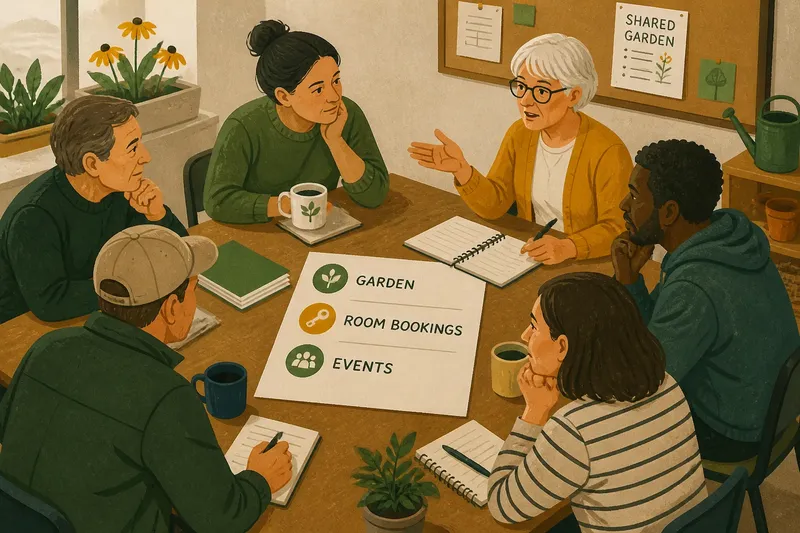
Someone arrives at a local group meeting with a notebook, a mug of tea and a question about the shared garden. The agenda says “Garden”, then “Room bookings”, then “Events”. By the end, everyone has talked, but nobody knows whether the garden plan was approved or who should check the bookings. A useful meeting agenda tells people not just what a subject is, but what the group needs to do with it.
Topics are labels; they are not outcomes. “Garden” could mean a quick update, a debate about priorities or a decision about buying compost. Those activities need different preparation and different kinds of participation. Distinguishing them on the agenda helps members judge when to listen, when to contribute and when their agreement is being requested.
Separate updates, discussion and decisions
An update shares information without asking the group to settle anything. It might report that the hall has been booked or that a volunteer has contacted a supplier. A short written note can often do this work, leaving meeting time for questions that genuinely need the room.
Discussion is for exploring a question before the group is ready to choose. Members might compare ways to keep the shared kitchen tidy, raise concerns about access or suggest options no one has considered. The agenda should make clear whether this is open exploration or a discussion intended to prepare a later decision.
A decision item names the choice the group needs to make. “Agree whether to use the community-room budget for a noticeboard or extra chairs” is more useful than “Room”. It gives members a fair chance to think ahead and makes it easier for the chair to recognise when the conversation has reached its purpose.
Think of an agenda like a set of labelled containers. A topic is the label on the outside; the type of work is what belongs inside. When the label says “discussion” but the group is expected to approve a proposal, people may feel ambushed. Clear labels prevent that mismatch.
Choose an agenda style that fits the work
A compact update-led agenda suits routine coordination
This approach gives brief space to recurring information: who has keys, what needs restocking, and which shared activities are coming up. It suits a group whose regular meeting mainly keeps everyday arrangements moving and whose members can read short reports beforehand.
Its risk is that updates can quietly swallow the meeting. If every report is delivered aloud, a gathering intended for coordination becomes a sequence of announcements. Put routine news in a circulated note where practical, and reserve the agenda for questions, exceptions or actions requiring the group.
A question-led agenda suits unresolved issues
Here, each item is framed around a question the group needs to explore: “What would make the tool cupboard easier for everyone to use?” This suits a group facing a real problem but lacking enough shared understanding to choose an answer.
Question-led discussion works best when the chair says what sort of contribution is useful and when the group will decide whether more exploration is needed. Otherwise, conversation can circle through personal preferences without producing a clearer picture of the issue.
A decision-led agenda suits choices that need a shared answer
This style identifies the proposal or alternatives, the decision sought and any relevant information members should read in advance. It suits choices that affect shared responsibilities, common resources or the way the group works together.
It is less suitable when members have not seen the proposal or when an important concern has not been heard. In those cases, label the item as discussion first, then schedule or identify a later point for the decision rather than disguising unfinished preparation as a vote.
Make the purpose visible before the meeting
A practical agenda can include the topic, its purpose, the person leading it and the intended outcome. For example, “Shared kitchen — update — caretaker — note the repair date” tells members that no approval is being sought. “Shared kitchen — decision — agree which storage plan to trial” signals that members should arrive ready to choose.
Say you are preparing an invented agenda for a neighbourhood group deciding how to share a small patch of planting space. The starting point is a vague item, “Garden”. You change it to “Discussion: identify the access and watering issues; decide whether to bring a planting proposal to the next meeting.” The expected observable result is that members leave knowing the group has not yet approved a planting plan, and that a proposal still needs to be prepared.
For each item, ask:
- Is this information for members, or does the group need to respond?
- What question or choice should the discussion address?
- Does the group have enough information to decide now?
- Who needs to prepare or lead the item?
- What should be recorded when the item ends?
These prompts are not a form to fill in mechanically. They help the person assembling the agenda notice when a topic has no clear purpose or when a decision has been placed before members without enough context.
Use meeting time fairly when opinions differ
When a decision affects people differently, the agenda should make room for the relevant voices before the group chooses. A chair might invite members to name practical constraints first, then compare options against an agreed need, such as ease of access or the work volunteers can reasonably take on. This keeps the discussion connected to the decision rather than turning it into a contest of confidence.
Some groups make decisions by consensus; others use a vote or a delegated decision process. The agenda need not settle the group’s rules, but it should not leave members guessing which process applies. If the group is not ready to decide, the chair can record what remains unresolved and what information or conversation is needed next.
How should an agenda signal its purpose?
Should every agenda item end in a decision?
No. Some items exist to share information or explore a question, and treating each one as a decision can pressure members into premature agreement. Label the purpose plainly so people know whether they are being asked to listen, contribute ideas or choose.
What belongs in an update rather than a meeting discussion?
Routine information that members can understand without a conversation often belongs in a written note. Bring it to the meeting when people need to clarify a consequence, raise a concern or agree on a response.
What if members are not ready to decide?
Record that the item remains open, identify the missing information or perspectives, and say who will bring them back. A deferred decision is clearer than a vague conversation that leaves members unsure whether anything was agreed.
How can members check what was decided afterwards?
Meeting notes should distinguish decisions from discussion and updates, then name any agreed action and its owner. Members can then see what the group settled and what still needs attention without relying on memory or informal retellings.
Choose the approach by the kind of work ahead
Use an update-led agenda when most items are routine and members need a concise shared picture. Choose question-led discussion when the group needs to understand a problem or hear different experiences before proposing a response. Use a decision-led agenda when members have a clear choice, enough background and an agreed way to reach an answer.
Many meetings need all three, but not every topic needs all three. A report about a room booking may take a moment; a question about who can access the room may need discussion; a change to the booking arrangement may require a decision. Naming each purpose makes the agenda a working agreement about how the group will spend its time.
When drafting a meeting agenda, read each item aloud and ask what members should be able to say when it ends. “We know the date”, “we have heard the options” and “we agreed which plan to use” are different outcomes. That small check helps the group leave with a shared understanding, even when the next useful action is to keep talking rather than decide.