The First Invitation: What a Newcomer Needs to Know
A clear first invitation names the activity, commitment and next step, helping newcomers decide whether joining suits them without having to guess.
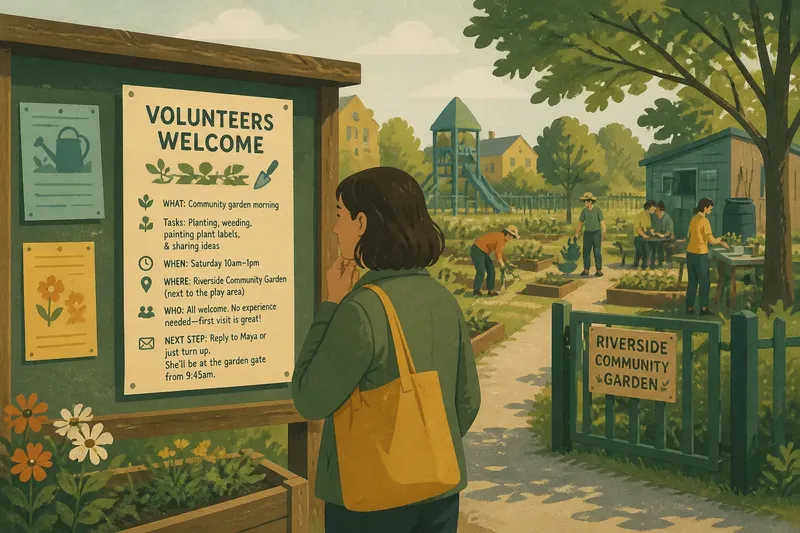
Someone pauses beside the community garden noticeboard, reads “Volunteers welcome”, then walks on. The invitation sounds friendly, but it leaves practical questions unanswered: What will I do? How long will I be expected to stay? Who should I contact? A first invitation works better when it answers these questions before a newcomer has to ask. That is the useful test for any invitation to join a local group.
Clarity is not a demand that every gathering follow a strict script. It is a way to make the first decision easier. Naming the activity, explaining the expected commitment and offering a clear next step lets people judge whether they can take part. If few new people respond, look first at what the invitation leaves uncertain, rather than assuming that nobody is interested.
When the invitation gets attention but no replies
A notice can be seen and still feel hard to answer. “Come and help at the hall” may raise more questions than it resolves: is this a cleaning session, a planning meeting or a social event? Must someone already know the group? Is there a particular task to prepare for? If readers need to guess what attendance means, staying away can seem simpler than enquiring.
The usual cause is a broad description standing in for an actual activity. Replace it with a plain account of what people will be doing together. “Help sort donated books for the community shelf” gives a prospective volunteer something concrete to picture. If the session includes more than one kind of activity, name the main one and mention the others briefly, instead of offering a cloud of possibilities.
Check the first sentence of the notice. Can a reader identify the activity without reading a paragraph of background about the group? Useful details include the task or purpose, the place, and the date and time. A name such as “garden morning” may sound welcoming to existing members, but a newcomer may not know whether it means planting, discussion or simply a chance to look around.
Keep the wording open without making the activity vague. “Join us to paint plant labels and talk about what to grow next” describes a shared task while signalling that a newcomer need not arrive with expert knowledge. That distinction matters: a person can be new to the group without being expected to arrive already competent in its particular routines.
When people worry they are agreeing to too much
“Come and see us” sounds relaxed, yet it can conceal an unwritten expectation. A newcomer may imagine that turning up means signing up for regular duties, taking responsibility for a project or staying until everyone leaves. If the group intends only to welcome someone for a single visit, say so. If ongoing help is welcome but not required, make that distinction plain.
The cause is often a missing boundary around commitment. State how long this particular activity is planned to last, whether one visit is useful on its own, and what further involvement would mean. Avoid promising that a person can leave at any moment if the activity has a practical reason for people to stay until a task is finished. Instead, explain the arrangement accurately and let them decide whether it suits them.
Say you are inviting a neighbour to a Saturday repair café. If the invitation says only “We need extra hands”, they may assume they must be a skilled repairer and stay for the whole event. A clearer version might say that the group will sort donated small items and greet visitors during the morning, that a first visit is welcome, and that no repair experience is needed for those tasks. The neighbour can then decide whether that particular contribution fits.
It helps to distinguish attendance from membership and a one-off contribution from a continuing role. Those are separate choices, even when the group would be pleased if someone returned. A first invitation should not make a small trial visit feel like a quiet contract.
When someone cannot tell whether the group is for them
People may hold back because an invitation assumes knowledge the organisers take for granted. Words such as “working bee”, “steward” or “setup crew” can be familiar to regulars and opaque to everyone else. So can a bare venue name, particularly if the group meets in a room reached through a side entrance rather than the building’s front door.
Look for insider shorthand and replace it with words a first-time visitor can act on. Describe the task, identify the meeting place in recognisable terms, and say whom to look for on arrival. Where there are practical conditions that shape participation—such as standing for much of the session or working outdoors—give that information plainly. This is more useful than a general assurance that everyone is welcome.
Do not guess what a person needs or make the invitation sound like an application. A simple contact route gives them the option to ask about the space, the activity or taking part in another way. If arrangements depend on the venue or activity, check the relevant organiser’s or venue’s instructions before describing them.
A short, specific invitation can carry warmth without relying on slogans. “We’ll be in the side room beside the library desk; Maya will be there to say hello” offers more reassurance than “Come along and meet the team”. It is rather like leaving a lamp on by the entrance: a small practical signal makes the way in easier to find.
When readers do not know what happens after they say yes
An invitation can explain the activity and the time commitment yet still leave a gap: what should someone do now? “Get in touch” is not a next step if the reader cannot tell whom to contact or what to write. A form with unfamiliar questions can create a different barrier, especially if it appears to require a firm commitment before a person has visited.
Choose one simple action and make it visible. Depending on the group, that could be replying to a named contact, sending a message to a group email address, or arriving at a clearly identified welcome point. Say what will happen after that action. “Reply to Jo if you’d like to come; she’ll confirm which entrance to use” is more actionable than “Contact us for details”.
Keep the next step in proportion to the invitation. Someone considering a first visit may need to know where to go, who will greet them and whether they need to bring anything. They probably do not need a long account of every group policy in the first message. Share essential information up front and give a straightforward way to ask for other details.
Make sure the contact route is one the group actually checks. An unmonitored inbox or a message directed to a volunteer who has left can make a friendly invitation feel like a closed door. If several people share responsibility for replies, identify a contact point that remains usable when one organiser is unavailable.
When useful details make the notice feel crowded
Adding detail can solve uncertainty, but a notice can become hard to scan if every possible question receives equal space. The answer is not to remove the practical information. It is to put the decision-making details where a reader can find them quickly, then leave background and optional detail for a follow-up message or a linked page if one is available.
Read the invitation as someone unfamiliar with the group. The activity should be easy to spot, followed by the expected commitment and the next action. Put information about the place and arrival alongside the date and time rather than burying it in a paragraph about the organisation’s history. Use short sentences and familiar words, not compressed labels that ask readers to decode a club’s internal language.
Before sharing the invitation, check that it answers these questions:
- What will participants actually do?
- Where and when should a newcomer arrive?
- How much time does this particular activity ask for?
- Is one visit useful, or is ongoing participation expected?
- What should someone bring, if anything?
- Who can answer a question or welcome them on arrival?
- What is the clearest way to say yes or ask for more information?
Each answer should help a reader make a decision. If the activity needs particular clothing or materials, name them; if nothing is needed, say that. If a task involves a requirement that could affect whether someone can join, describe it plainly rather than hiding it under “all welcome”.
Which details make a first invitation feel clear?
Should the invitation explain the whole group?
No. Give enough context to make the activity understandable, then focus on what a first visit involves. A brief note about the group’s purpose can help, but a newcomer should not have to read its full history to work out what is happening.
Is it better to ask people to register or simply arrive?
Use the option that fits the activity and the group’s arrangements. If organisers need a reply to prepare, say why and name the contact route; if people can simply arrive, make the meeting point and welcome contact clear.
How should a group describe a flexible commitment?
Be specific about what is flexible, such as whether a first visit can be a one-off or whether a person may choose among tasks. Do not use “drop in” if the activity requires people to arrive at a particular time or remain for a shared task.
What if the activity changes after the invitation is sent?
Tell invited people directly and explain what has changed, including the new activity or arrangements and whether they need to respond again. A clear update respects their time and avoids asking them to turn up based on information that is no longer current.
Make the invitation easy to act on
Before sending a notice, ask someone who does not attend the group to read it. Do not ask whether it sounds appealing; ask what they think they would do, how long they expect to stay and what they would do if they wanted to come. Any uncertainty in their answer points to a missing detail, not a need for a more persuasive slogan.
The first invitation is a small agreement about what a person can expect. Name the activity, state the commitment honestly and show the next step. When those pieces are clear, a newcomer can choose with confidence whether to join this time—and the group can welcome them without making them decode the invitation first.