Open Table or Sign-Up List? Choosing a Gathering Format
Choose an open table or sign-up list for a community gathering by matching flexibility to preparation, so hosts can plan well without shutting people out.
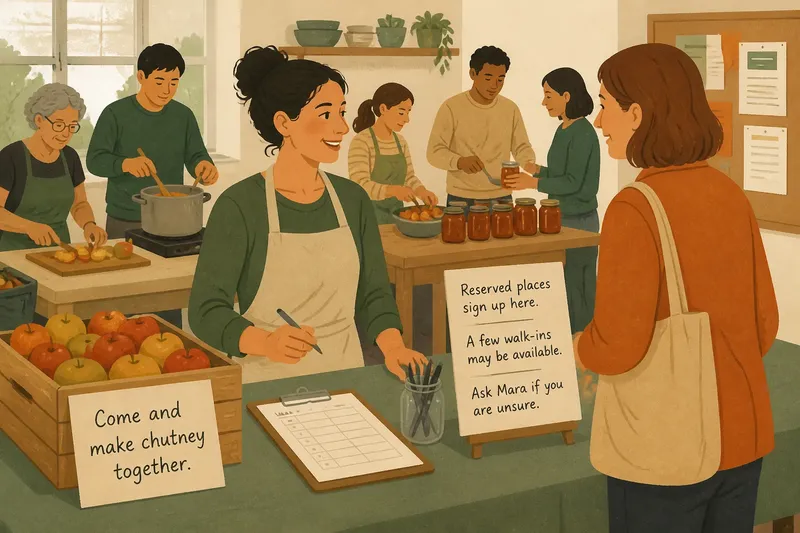
At the community hall, a box of donated apples sits beside a handwritten note: “Come and make chutney together.” Should anyone be able to walk in, or should the organiser ask people to sign up first? Choosing an open table or sign-up list for a community gathering is less about which format sounds friendlier and more about what the activity asks people to prepare.
Consider a clearly invented situation. Mara is organising an afternoon chutney-making session for a neighbourhood group. She has a shared kitchen, a few large pans and a limited supply of jars. Some neighbours like to decide on the day; others need to know in advance whether there will be a place for them. Her choice affects both the work before the gathering and the freedom people have to join.
Start with the work participants will need to do
For Mara, this is not a casual chat with snacks. Participants will wash and chop fruit, take turns at the hob and help fill jars. The activity needs ingredients, clean equipment and enough people to share tasks without crowding the kitchen. That makes preparation part of the gathering itself.
An open table welcomes people to arrive without booking, perhaps during a stated window. It suits activities that can absorb an uncertain turnout: a conversation table, a craft session with spare materials, or a communal reading hour. Hosts need to prepare a flexible core rather than plan around an exact headcount.
A sign-up list asks people to reserve a place before the event. That gives organisers a clearer basis for buying supplies, dividing roles and setting up the room. It also asks participants to decide earlier, which can be difficult for people with changing shifts, caring duties or uncertain transport.
The useful question is not simply whether the event is “open”. It is whether someone can arrive late, leave early or take part without disrupting a task that depends on a particular number of hands.
Match the format to the activity’s limits
Mara considers what would happen if only a few people came, or if more neighbours arrived than she had jars for. A small turnout would still allow the group to prepare fruit and share the work. A sudden crowd, however, could leave people waiting around a busy kitchen.
She could use a sign-up list with a clear closing point, but that would exclude the neighbour who hears about the event late. Instead, she decides on a hybrid arrangement: people may sign up for a reserved place, while a small number of walk-in places remain available if the room and supplies allow. The invitation explains that walk-ins should check with the named organiser before travelling.
This is not a promise that everyone can join. It is a way to make the constraint visible before someone arrives. If the activity depends on specialist tools, individual instruction or a fixed team, a firmer booking system may be kinder than an open door that cannot be managed.
Choose the right amount of certainty
Advance sign-up can be a short list on paper, a shared spreadsheet, a phone number or an online form. The best choice is one the intended participants can actually use. A digital form may be convenient for some neighbours, while a paper sheet at the library or a phone contact can offer another route.
Keep the request proportionate. For Mara’s session, a name and a way to contact the person are enough to confirm a place and share any practical update. Asking for extra personal details would add work without helping her arrange the kitchen.
An open table also needs organisation. Hosts should decide who welcomes arrivals, where latecomers can join, and what people can do if the main activity is already full. A sign that says “Ask Jo about a place” is more helpful than a vague notice that leaves newcomers guessing.
Think of the format like a table with leaves: a flexible arrangement can expand for extra guests, but only if there is room to do so. The image is useful up to a point; unlike furniture, people also need clear expectations about whether a place is waiting for them.
What should you tell people before they come?
Does an open table mean anyone can arrive at any time?
Not necessarily. State the arrival window and say whether late arrivals can still join the activity, so people do not have to infer the rules from the word “drop-in”.
When is a sign-up list the better choice?
Use advance booking when materials, space or shared tasks have a practical limit. Tell people how to reserve a place and what to do if they can no longer attend.
How can organisers include people who cannot plan ahead?
Where capacity permits, hold some places for walk-ins or offer a way to ask about availability on the day. If no flexible places are possible, say so plainly and consider a later session with a different format.
What should happen if more people arrive than expected?
Name someone who can explain the options, such as joining a later session or taking part in a separate, suitable task. Avoid implying that a waitlist or walk-in place exists unless the group can manage it.
Make the arrangement clear and workable
Mara writes a short invitation with the activity, time, location, booking contact and the number of reserved places. She adds that a few walk-ins may be accommodated if space remains, and asks people to contact her before setting out if they are unsure. She does not require anyone to explain why they cannot book in advance.
On the day, she puts a simple list by the entrance and asks a second volunteer to welcome arrivals. The reserved participants provide a dependable starting group; the walk-in option leaves room for neighbours who decide late. If the kitchen reaches its safe working capacity, the volunteer can explain that there is no place available rather than trying to squeeze another person in.
Afterwards, Mara notices that the format shaped the work as much as the invitation did. The list helped her prepare the main batch, while the walk-in places made the event less dependent on early decisions. For another activity with limited equipment or closely timed instruction, she might choose sign-up only. For a conversation that can grow around an extra chair, an open table may ask less of everyone.
When choosing an open table or sign-up list for a community gathering, describe the actual boundary: what can be flexible, what needs to be prepared, and who can answer a question before someone travels. That small piece of clarity lets participants decide whether the arrangement works for them, while giving organisers a plan they can carry out.